Admin API
It lives in the core, not in the panel package. Deliberately: if the panel is replaced tomorrow
the API remains, and with it everything integrated on top. Same separation as iam-console and
iam-server.
// config/routines.php
'api' => [
    'prefix' => 'api/routines/v1',
    'middleware' => ['web', 'auth'],   // your guard
],
Permissions are fail-closed
Resolved through the host application’s Gate: routines.read, routines.write, routines.fire,
routines.approve. An ability with no policy defined is denied, except routines.read.
An application that mounts the API without defining anything gets a read-only panel — the right
default for a tool that starts automations. The cost of having to define policies is an annoyance;
the cost of the opposite is an automation started by someone who should not have.
The server writes the human-readable text
schedule_human, suspension_reason_label, tick_diagnosis, and a fire’s question.
A client translating target_not_registered into a sentence would translate it differently from
the CLI, the notification email and the audit — and three people looking at the same event would
read three different things.
Endpoints
| Method | Path | Notes |
|---|---|---|
GET |
/capabilities |
What is installed. Call it first. |
GET |
/targets |
Registry descriptors — including types used but not registered |
POST |
/schedule/preview |
Next occurrences + the sentence, without needing an existing routine |
GET POST |
/routines |
List (cursor paging) · create |
GET PATCH |
/routines/{id} |
Detail · update |
POST |
/routines/{id}/pause · /resume · /end · /fire · /duplicate |
|
GET |
/attention |
Fires waiting for an answer, oldest first |
GET |
/runs · /runs/{id} |
The ledger |
POST |
/runs/{id}/approve · /reject |
Reject requires a reason |
GET |
/stats/overview · /stats/timeline · /health |
Details worth knowing
/schedule/preview needs no routine. It is used in the creation wizard, while the user is still
typing — which is where a preview prevents a mistake, not after saving.
next_occurrences flags dst_transition. The occurrence where the offset changes relative to
the previous one: the UTC instant moves by an hour while the local time stays the same. It is the
question users ask themselves twice a year looking at the logs.
Duplicating does not inherit the mandate, and the copy starts paused. The consent was given for
that routine; transferring it would authorise something nobody approved.
Answering the same request twice returns 200 with the current state, not an error. The second
answer is not the caller’s mistake, and it must not produce a second execution.
Sorting is on an allow-list. sort arrives from the query string, and passing it to orderBy
unfiltered would let a parameter choose which column to interrogate.
The timeline has no holes. The full series is built and then filled: a day with no executions is
a zero, not a gap. A chart with gaps lies about the cadence.
Errors: RFC 9457
{
  "type": "https://padosoft.dev/problems/validation",
  "title": "Il dato inviato non è valido",
  "status": 422,
  "detail": "email: That is not a valid address.",
  "errors": { "email": ["That is not a valid address."] }
}
Same format as the iam-server Admin API — not for cosmetic uniformity: a client that can read one
problem+json can read them across the whole ecosystem, and detail is always a sentence you can
show a person without reworking it.
/health diagnoses, it does not merely report
{
  "tick_healthy": false,
  "tick_diagnosis": "Ultimo tick 47 minuti fa: lo scheduler di Laravel non sta girando, e finché non riparte nessuna routine partirà. Controlla il cron di sistema (`* * * * * php artisan schedule:run`) e che il processo sia vivo.",
  "overdue": [...],
  "stuck_locks": [...],
  "targets": [{ "type": "flow", "registered": false, "routines_count": 3 }]
}
A panel saying “last tick 47 minutes ago” has informed you. One saying “the scheduler is not
running, check the cron” has solved it.
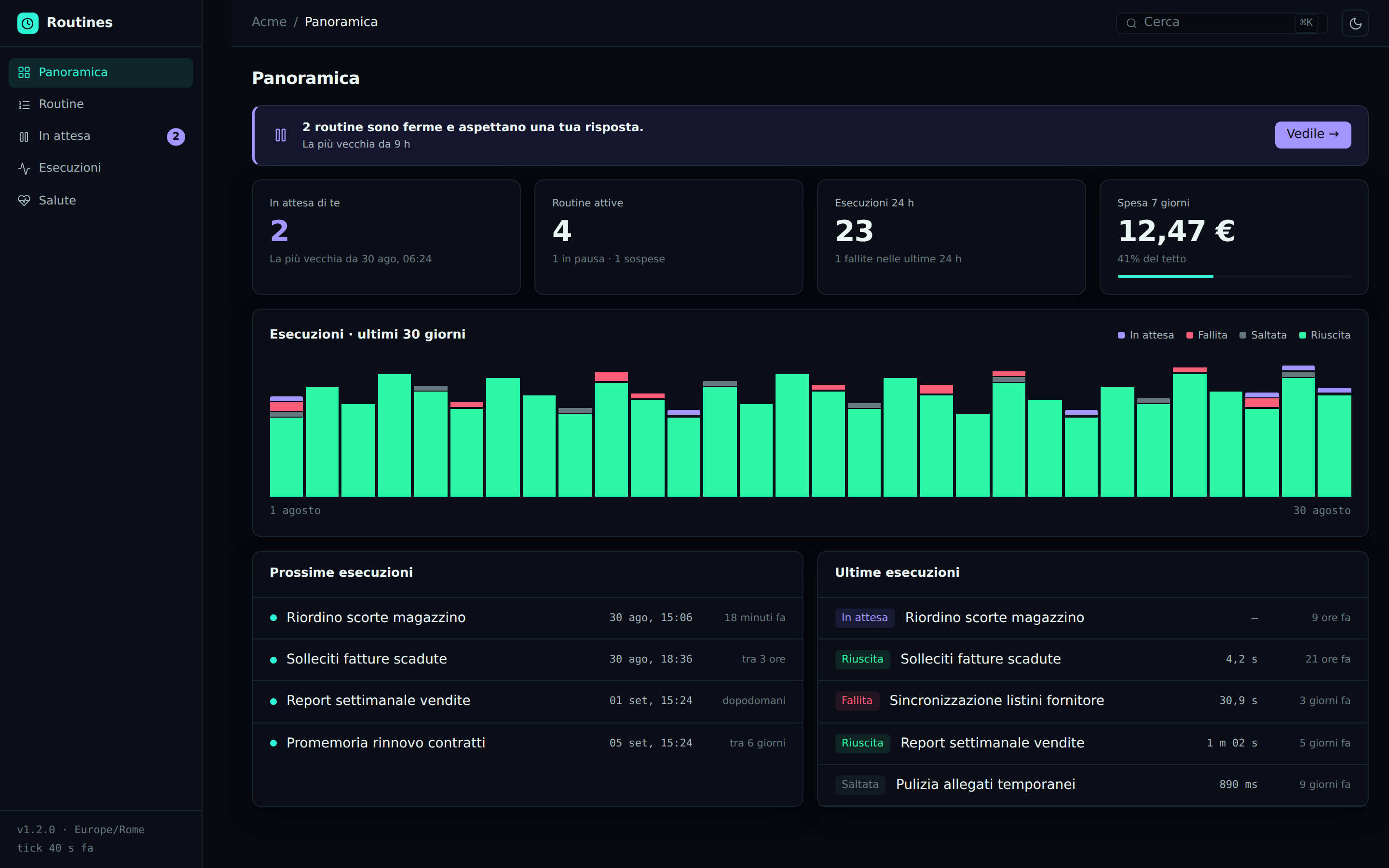
The panel that consumes it
padosoft/laravel-routines-admin is a React
SPA built entirely on this API — no server-side state, no Blade beyond the mount view. It is the
reference consumer, but not a privileged one: everything it does is available to anything else that
speaks HTTP.
composer require padosoft/laravel-routines-admin
php artisan vendor:publish --tag=routines-admin-assets
The separation is deliberate. If the panel is replaced tomorrow the API stays, and with it every
integration built on top — the same split laravel-iam-console has from laravel-iam-server.
Two things the panel relies on, and that any other client should too:
- The server composes every human-readable string.
schedule_human,suspension_reason_label,
tick_diagnosisand a paused fire’smessageare evidence, not copy. A client that translated
target_not_registeredon its own would translate it differently from the CLI, the notification
email and the audit — and three people looking at the same event would read three different
things. POST /schedule/previewneeds no routine. It exists so a wizard can show five real dates
before there is anything to save, which is what stops the product’s most common bug: a schedule
that looks obviously right and fires at another hour because the routine’s timezone is not the
author’s.
